
Un article relatant 2 essais cliniques sur l’intérêt de l’ibuprofène en traumatologie, réalisés par une équipe canadienne qui travaille sur ce thème depuis des années.
Acetaminophen (Paracetamol) or Opioid Analgesia Added to Ibuprofen for Children’s Musculoskeletal Injury
À lire 🔗 https://jamanetwork.com/journals/jama/article-abstract/2843665
Points clés
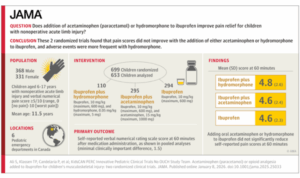
Question L’ajout d’acétaminophène ou d’hydromorphone à l’ibuprofène améliore-t-il le soulagement de la douleur chez les enfants présentant une lésion aiguë d’un membre ne nécessitant pas d’intervention chirurgicale ?
Résultats Dans ces deux essais cliniques randomisés portant sur 699 enfants admis aux urgences moins de 24 heures après une lésion aiguë des membres ne nécessitant pas d’intervention chirurgicale, l’ajout d’une dose d’acétaminophène ou d’hydromorphone par voie orale à l’ibuprofène n’a pas réduit de manière significative les scores de douleur auto-déclarés au bout de 60 minutes. L’utilisation de l’hydromorphone a entraîné une multiplication par quatre des effets indésirables.
Conclusion Chez les enfants présentant des traumatismes aigus des membres ne nécessitant pas d’intervention chirurgicale, les scores de douleur ne se sont pas améliorés avec l’ajout d’acétaminophène ou d’hydromorphone à l’ibuprofène ; les effets indésirables étaient plus fréquents avec l’hydromorphone.
Résumé
Importance L’ibuprofène constitue le traitement de première intention des douleurs musculo-squelettiques. Cependant, deux tiers des enfants ne bénéficient pas d’un soulagement suffisant de la douleur avec l’ibuprofène en monothérapie, et l’efficacité des médicaments d’appoint dans le traitement des douleurs musculo-squelettiques modérées à sévères reste incertaine.
Objectif Déterminer si un traitement associant un opioïde (hydromorphone) à l’ibuprofène ou un non-opioïde (acétaminophène [paracétamol]) à l’ibuprofène permettait de réduire les scores de douleur par rapport à l’ibuprofène seul.
Conception, cadre et participants Deux essais randomisés, en double aveugle et contrôlés par placebo ont été menés d’avril 2019 à mars 2023 dans six services d’urgence pédiatriques canadiens de soins tertiaires rattachés à des universités. Ont été recrutés des enfants âgés de 6 à 17 ans présentant une lésion aiguë d’un membre ne nécessitant pas d’intervention chirurgicale (< 24 heures) et un score de douleur de 5 ou plus sur 10 selon l’échelle numérique verbale ( vNRS). La date du suivi final était le 22 mars 2023.
Interventions Dans l’essai sur les opioïdes, les participants ont été randomisés pour recevoir une dose orale unique d’ibuprofène associé à de l’hydromorphone, d’ibuprofène associé à de l’acétaminophène, ou d’ibuprofène seul. Dans l’essai sur les non-opioïdes, les participants ont été randomisés pour recevoir une dose orale unique d’ibuprofène associé à de l’acétaminophène ou d’ibuprofène seul. Dans tous les groupes, l’ibuprofène était administré à la dose de 10 mg/kg (maximum : 600 mg). La dose d’acétaminophène était de 15 mg/kg (maximum : 1 000 mg) et celle d’hydromorphone de 0,05 mg/kg (maximum : 5 mg).
Principaux critères d’évaluation et mesures Le critère d’efficacité principal était le score de douleur d’échelle numérique auto-évalué 60 minutes après l’administration du médicament
Résultats Au total, 8 098 enfants ont fait l’objet d’un dépistage d’éligibilité ; 699 ont été randomisés et 653 ont été inclus dans les analyses d’efficacité. L’essai sur les opioïdes a porté sur 249 enfants : 110 ont été randomisés dans le groupe « ibuprofène plus hydromorphone », 70 dans le groupe « ibuprofène plus paracétamol » et 69 dans le groupe « ibuprofène seul ». L’essai sur les traitements non opioïdes a inclus 450 enfants : 225 ont été randomisés pour recevoir une dose unique par voie orale d’ibuprofène associé à du paracétamol et 225 pour recevoir de l’ibuprofène seul. L’âge moyen (écart-type) des enfants dans les deux essais était de 11,5 (3,5) ans et 47,4 % d’entre eux étaient des filles. Le score d’échelle numérique moyen (écart-type) au moment du recrutement était de 6,4 (1,8). Dans les analyses groupées, les scores d’échelle numérique moyens (écart-type) 60 minutes après l’administration du médicament étaient de 4,8 (2,6) dans le groupe « ibuprofène plus hydromorphone », de 4,6 (2,4) dans le groupe « ibuprofène plus paracétamol » et de 4,6 (2,3) dans le groupe « ibuprofène seul » (P = 0,78). Les événements indésirables ont été plus fréquents dans le groupe « ibuprofène plus hydromorphone » (28,2 %) que dans les groupes « ibuprofène plus paracétamol » (6,1 %) ou « ibuprofène seul » (5,8 %). Aucun événement indésirable grave n’a été observé.
Conclusions et pertinence Chez les enfants présentant une lésion musculo-squelettique aiguë ne nécessitant pas d’intervention chirurgicale, les scores de douleur 60 minutes après l’administration du médicament ne se sont pas améliorés avec l’ibuprofène associé à l’acétaminophène ou à l’hydromorphone par rapport à l’ibuprofène seul. Les effets indésirables étaient quatre fois plus fréquents avec l’hydromorphone.
Traduit avec DeepL.com (version gratuite)
Key Points
Question Does addition of acetaminophen or hydromorphone to ibuprofen improve pain relief for children with nonoperative acute limb injury?
Findings In these 2 randomized clinical trials of 699 children who presented to an emergency department less than 24 hours after a nonoperative acute limb injury, addition of 1 dose of oral acetaminophen or hydromorphone to ibuprofen did not significantly reduce self-reported pain scores at 60 minutes. Use of hydromorphone resulted in a 4-fold increase in adverse events.
Meaning For children with acute nonoperative limb injuries, pain scores did not improve with addition of either acetaminophen or hydromorphone to ibuprofen; adverse events were higher with hydromorphone.
Importance Ibuprofen is first-line therapy for musculoskeletal pain. However, two-thirds of children experience inadequate pain relief with ibuprofen monotherapy, and the efficacy of additive medications for moderate to severe musculoskeletal pain is unclear.
Objective To determine whether treatment with an opioid (hydromorphone) plus ibuprofen or nonopioid (acetaminophen [paracetamol]) plus ibuprofen decreased pain scores compared with ibuprofen alone.
Design, Setting, and Participants Two randomized, double-masked, placebo-controlled trials were conducted from April 2019 to March 2023 in 6 university-affiliated, tertiary care Canadian pediatric emergency departments. Children aged 6 to 17 years presenting with a nonoperative acute limb injury (<24 hours) and a verbal numerical rating scale (vNRS) pain score of 5 or more out of 10 were enrolled. Date of final follow-up was March 22, 2023.
Interventions The opioid trial randomized participants to a single oral dose of ibuprofen plus hydromorphone, ibuprofen plus acetaminophen, or ibuprofen alone. The nonopioid trial randomized participants to a single oral dose of ibuprofen plus acetaminophen or ibuprofen alone. In all groups, ibuprofen was dosed at 10 mg/kg (maximum, 600 mg). The acetaminophen dose was 15 mg/kg (maximum, 1000 mg), and the hydromorphone dose was 0.05 mg/kg (maximum, 5 mg).
Main Outcomes and Measures The primary efficacy outcome was self-reported vNRS pain score at 60 minutes post medication administration (score range, 0 [no pain] to 10 [worst pain]; minimal clinically important difference, 1.5). The primary safety end point was the proportion of children with any adverse event related to study drug administration.
Results A total of 8098 children were screened for eligibility; 699 were randomized and 653 were included in the efficacy analyses. The opioid trial included 249 children: 110 randomized to ibuprofen plus hydromorphone, 70 to ibuprofen plus acetaminophen, and 69 to ibuprofen alone. The nonopioid trial included 450 children: 225 randomized to a single oral dose of ibuprofen plus acetaminophen and 225 randomized to ibuprofen alone. The mean (SD) age of children in the 2 trials was 11.5 (3.5) years and 47.4% were female. The mean (SD) vNRS score at recruitment was 6.4 (1.8). In pooled analyses, mean (SD) vNRS scores 60 minutes after drug administration were 4.8 (2.6) in the ibuprofen plus hydromorphone group, 4.6 (2.4) in the ibuprofen plus acetaminophen group, and 4.6 (2.3) in the ibuprofen alone group (P = .78). Any adverse event occurred at higher rates in the ibuprofen plus hydromorphone group (28.2%) compared with the ibuprofen plus acetaminophen (6.1%) or ibuprofen alone groups (5.8%). No serious adverse events occurred.
Conclusions and Relevance For children with acute nonoperative musculoskeletal injury, pain scores at 60 minutes after drug administration did not improve with ibuprofen plus acetaminophen or ibuprofen plus hydromorphone compared with ibuprofen alone. Adverse events were 4-fold more frequent with hydromorphone.
Trial Registration Clinicaltrials.gov Identifier: NCT03767933
MàJ 23 février 2026